AI Fluent Process
Synchronizing Product and Design through an AI-native workflow that compresses weeks of iteration into hours
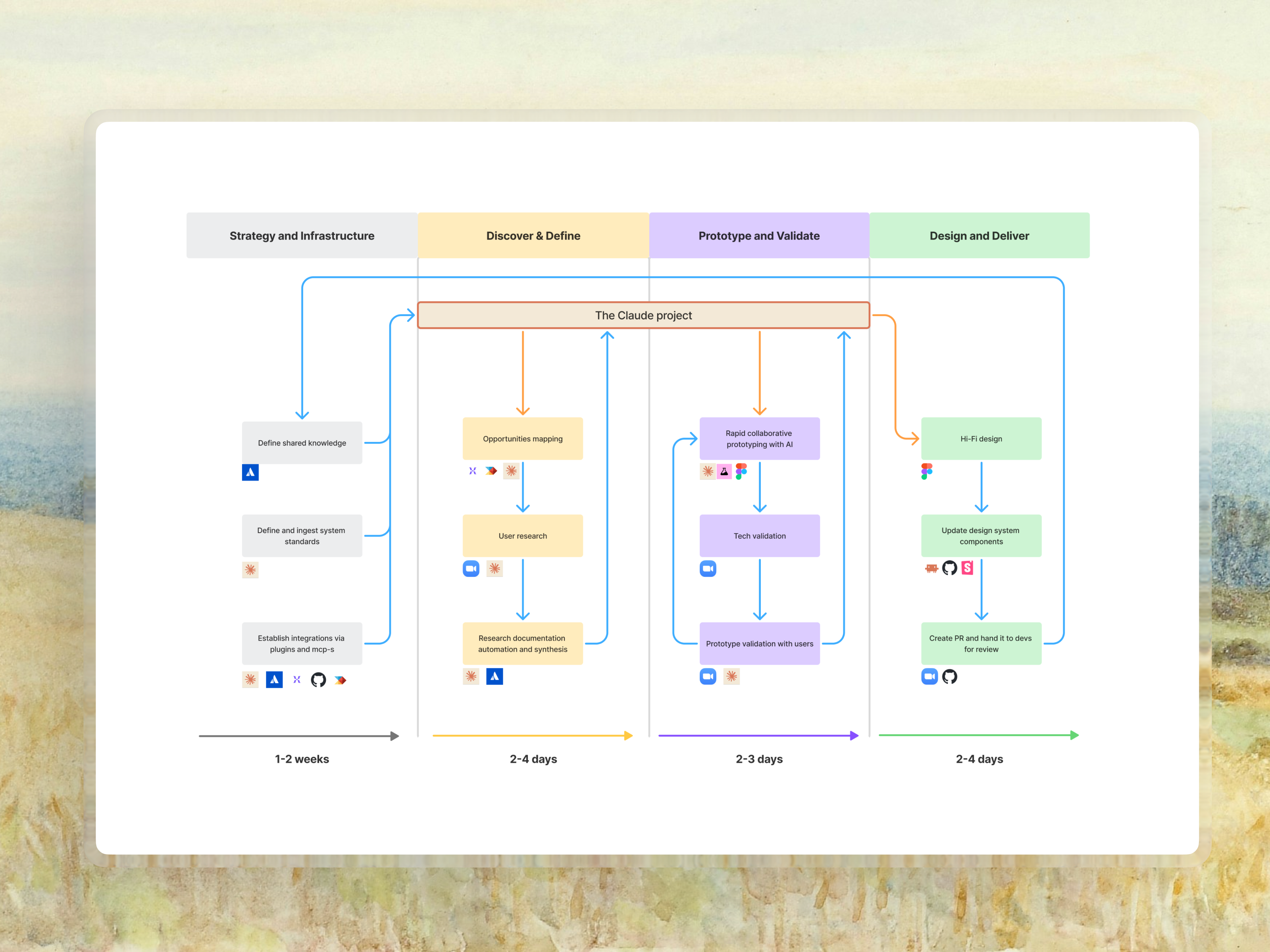
With Claude rapidly expanding into every sphere of IT, the incentive to rely on traditional, linear workflows has vanished. When every team member has access to an intelligent collaborator, the focus shifts from managing tasks to refining outcomes. We are no longer just moving tickets; we are validating ideas in real-time.
The Traditional Cycle (Pre-AI)
Historically, developing a new feature was a sequential marathon:
- Discovery: Fragmented research, often disconnected from engineering.
- Ideation: Searching for a solution’s “shape” in a vacuum.
- Alignment: Manually matching designs to business goals and tech constraints.
- Iteration: Slow prototyping cycles and manual feedback loops.
- Handoff: The high-friction transfer from design to development.
Each phase could take weeks or months. Today, that timeline is compressed into hours or days.
The Integrated Product Workflow
In a modern product company, AI acts as the connective tissue between business strategy, design, and execution.
1. Strategy & Infrastructure
We defined a shared technical and strategic “playing field” for the team:
- Business Intelligence: Claude ingests the company overview, market limitations, and core product principles.
- System Standards: The design system and development guidelines serve as the AI’s “source of truth.”
- Active Integrations: Through MCPs and Claude Code, the AI connects directly to Jira, Figma, Productboard, and Mixpanel
2. Discover and Define
- Opportunity Mapping: Claude identifies friction points in feedback systems and aligns them with product analytics to surface high-value tasks.
- Research Processing: AI transcribes user interviews instantly. Findings are centralized in a Claude Project, allowing the entire team to query the raw data.
- Automated Documentation: Claude analyzes these insights to draft a Product Requirements Document (PRD) that accounts for existing technical constraints.
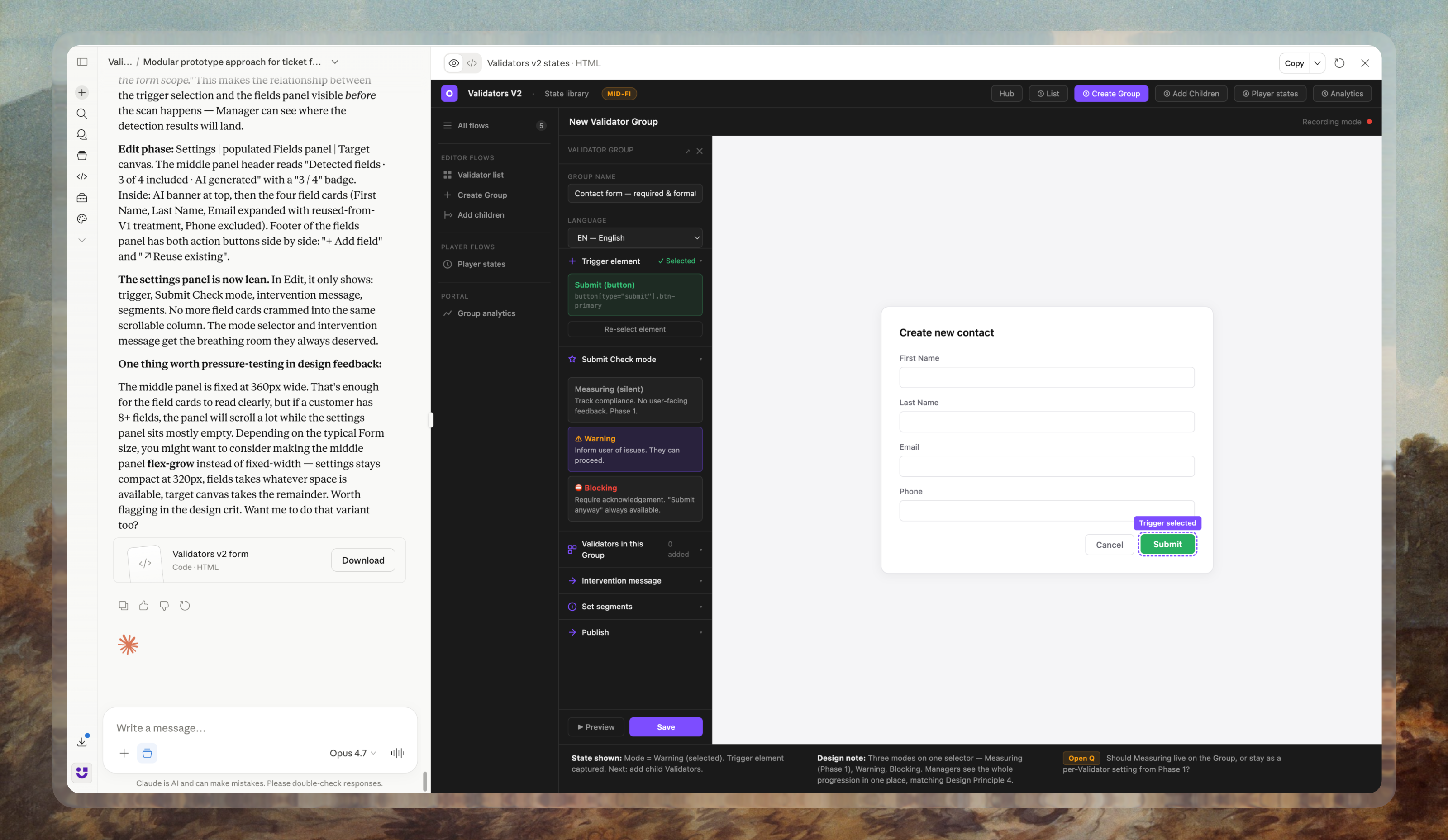
3. Prototype and Validate
The workflow shift is most visible here — instead of a designer working in isolation, the Designer, Product Manager, and Tech Lead run a live session:
- Instant Iteration: Adjust logic and user flows during the meeting.
- Technical Validation: Catch bottlenecks and UX friction points before high-fidelity work begins.
- Unified Shaping: The team builds the feature’s foundation together, ensuring immediate alignment.
4. Design and Deliver
The traditional “handoff” is replaced by synchronized technical execution:
- AI-Readable Annotations: High-fidelity Figma designs include annotations structured for both human designers and AI agents.
- Automated PR Generation: Using Claude Code, the team generates Pull Requests for new design system components, and new feature.
- Synchronized Review: Designers and developers review code and UI simultaneously, closing the gap between the mockup and the production environment. From this point designer only supports devs in their part.
Summary
Efficiency Gain: Process duration has shifted from weeks to days, and days to hours. By leveraging AI for synthesis and boilerplate, the product team can focus exclusively on problem-solving.